

I’m a fan of journaling, and when I discovered travel journals, I decided that I wanted to do those, too. Keeping a travel journal isn’t just a fun way to record your trip—it’s a deeper way to connect with what the trip meant to you.
When I travel, I don’t usually like hopping from one tourist destination to the next. Over the years, I’ve fallen in love with slower, more meaningful travel. The kind where you roam back alleys and discover the road less traveled. The one where you interact with locals and get to know more about a certain culture. The one that makes you think—and then write about it in your journal.
If you’re wondering how to start a travel journal or you already have one, but are wondering what to write in it, this post gives you the rundown on how to preserve travel memories and document your trips.
Why should you keep a travel journal?
For memory and documentation
Keeping a travel journal—a journal specific to your trip—is one way to preserve all the moments and memories. While photos capture what you saw, your journal captures how you felt—from the smells to the sounds to the energy of being in an unfamiliar place. Pictures won’t capture that for you.
For self-awareness and reflection
There’s nothing that pushes you out of your comfort zone or places you in unfamiliar situations the way travel does. Writing lets you self-reflect on what those experiences mean to you—what excites you, what drains you, what challenges you. A travel journal is a record of who you were at a specific point in your life, and rereading it in the future can reveal many things about yourself.
For presence and mindfulness
Keeping a travel journal makes you pay closer attention during the day—especially if you know you’ll write about it later. You’ll pay attention to more details and notice more things that you would otherwise walk past or gloss over.
For creativity
Journaling exercises your creative muscles even if you aren’t a writer or an artist. You can express yourself in various ways. Your travel journal can even become the foundation for a blog, a photo book, or a memory keeper that you share with family or future generations.
For practical purposes
Travel journals can also serve as a reference for visa trips, especially if you fill them with practical guides—visa information, hidden gems, tips from locals, and even what you’d do differently if you were to visit the place again.
What to bring with your travel journal
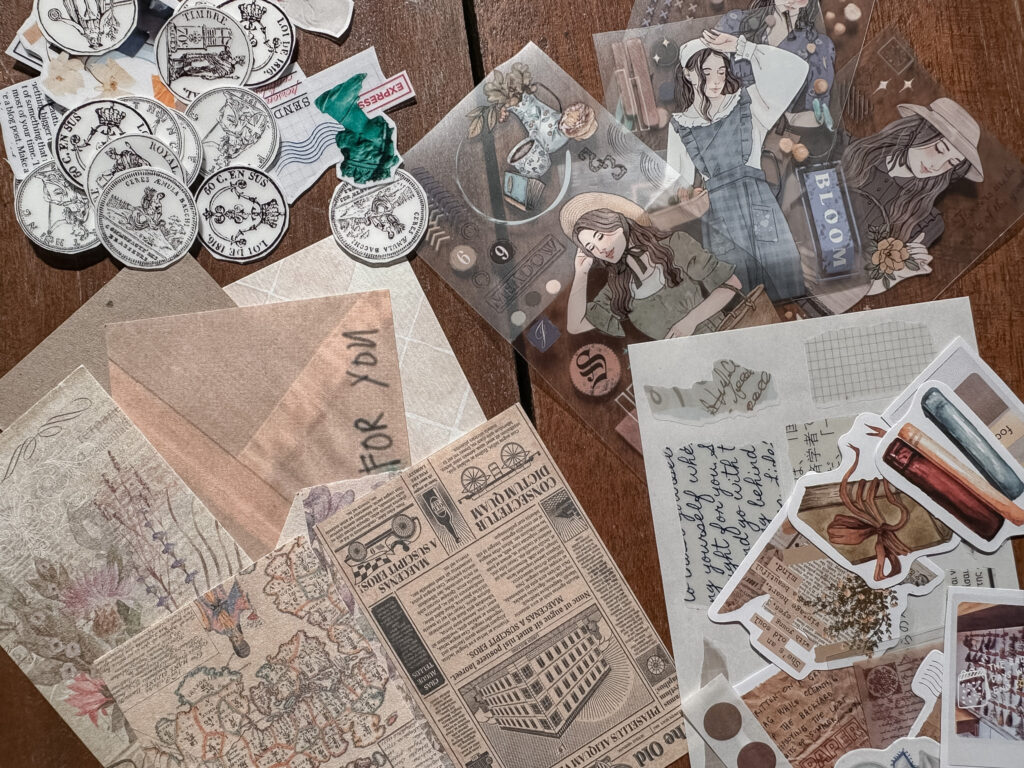
Whenever I travel, I like to bring some journaling items with me—not too many because I know I’ll be filling my journal with other stuff I’ll gather from my trip.
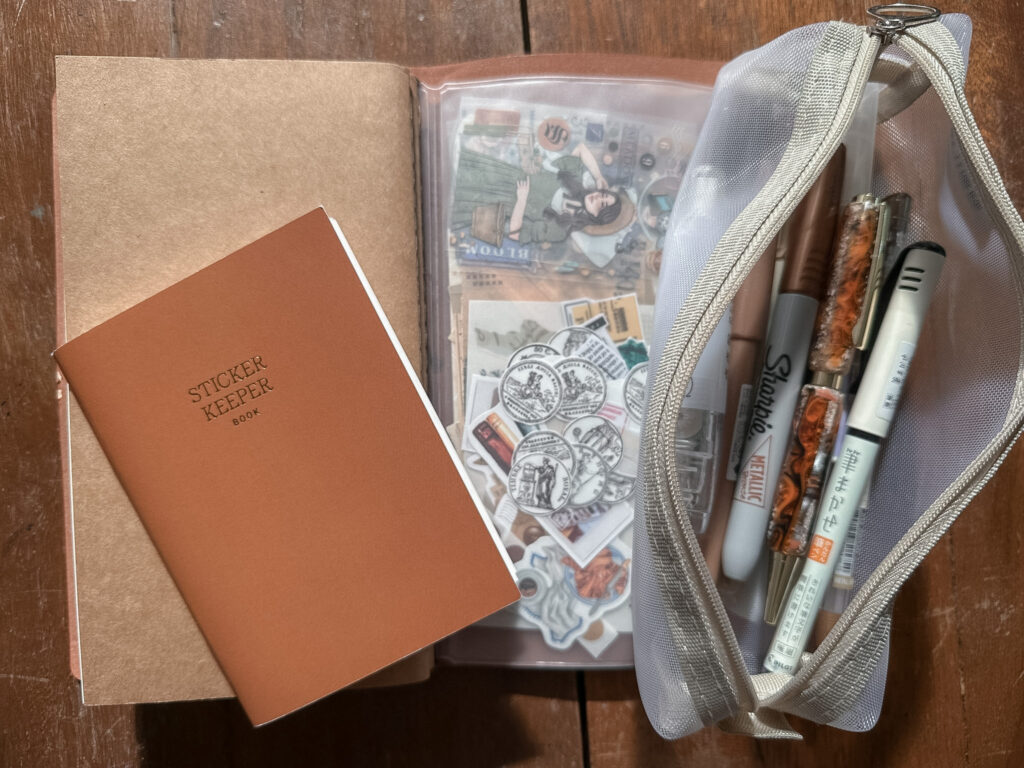
- A passport-sized notebook or Traveler’s Notebook
- Some of your favorite pens
- A glue stick or tape stick
- Some washi tape
- Some stickers (you can put them in a sticker book)
- Some bits and pieces of paper
- A small watercolor set (if you’re artsy)
The point is to bring what will help you as you journal—not an entire box of things that you won’t be able to use. If you like to travel light, you’ll need to keep your items to a minimum so you have space and allowable weight for other things. And if you’re traveling with only a carry-on, you may not be able to bring things like scissors and paper cutters, no matter how tiny they may be.
10 tips for keeping a travel journal
Start while you’re traveling.
Don’t wait until after your trip to start your journal. If you wait till after your trip, there’s a huge chance that you’ll have forgotten a lot of things you need to get down.
Write at the same time each day.
Schedule a downtime for updating your travel journal each day, such as at the end of the day, just before bed, or on the following morning while you’re having your coffee. Routine helps you actually do something. Plus, you’ll get to record everything while the memory is still fresh.
Always write down the date and location.
Memory fades fast. It’s best to capture what you can rather than spend a good deal of the day racking your brain for some details of your trip. Even a quick note, “April 24, Train to Hanoi,” will give you the context you’ll treasure later.
Use anything and everything.
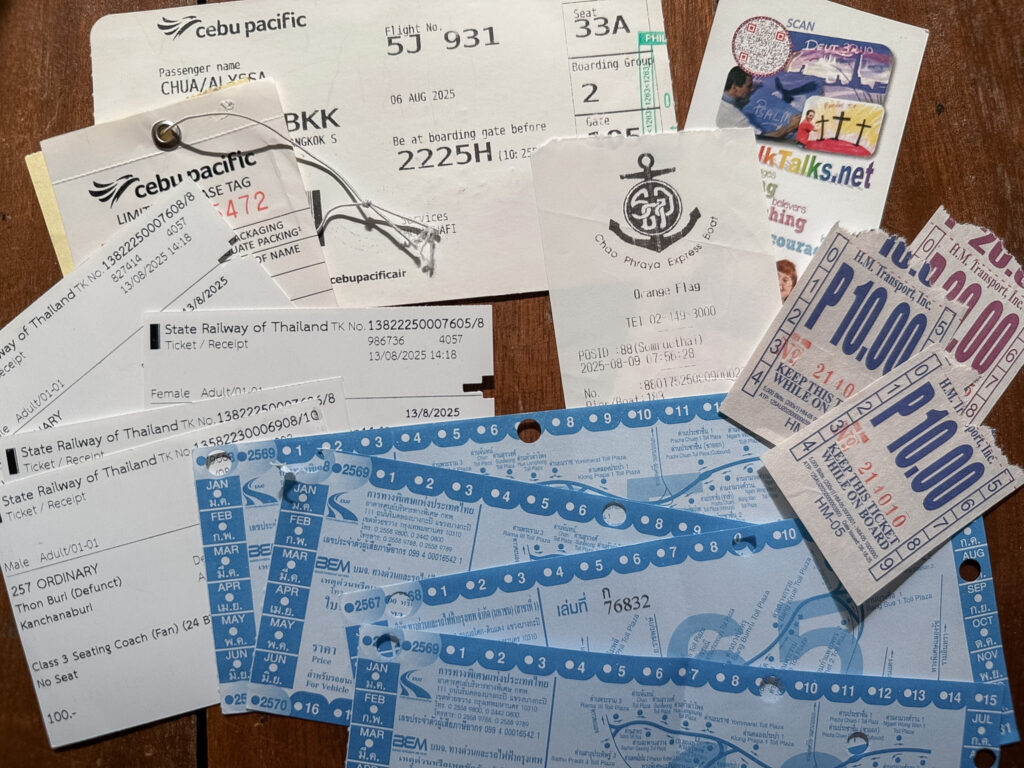
I don’t encourage becoming a hoarder, but when travel journaling, you can use so many different things! From bus tickets to train passes to napkins with restaurant logos on them to coffee holders with cute catchphrases—the list is endless!
Let go of perfectionism.
You know that journal spread you’ve been drooling all over on Pinterest or IG? Yes? Well, that’s a suggestion and should serve as only inspiration—not final authority.
Let your personality shine through.
You’re journaling for yourself. To build your memories. To keep the details of your trip in one place so that you can refer back to them when time passes. And so your travel journal must be something you like—not just something you enjoy putting together, but something that you’ll enjoy reading several years down the road.
Capture the mundane.
Life isn’t always filled with dramatic moments—and honestly, I’m not sure we want it to. Instead, write about what you ate, what the weather felt like, a conversation you overheard, how the sunset looked. These small details and how you felt will make your journal come to life when you pick it up to read again.
Sketch, use stickers—don’t just write.
Even stick figures are acceptable, or a rough street layout or a building façade can add to your journal’s character. You don’t have to be artistic (I can’t draw to save my life). Or you can use stickers or print polaroids.
Write to someone.
A fun way to write your travel journal would be to frame your entries as if you were writing a letter to a friend or your future self or even a fictional reader. Sometimes, it can help move you beyond writer’s block if you’re staring at a blank page and don’t know where to start.
Make notes of what surprised you.
We all have expectations when we travel, and sometimes, the reality can be so different. In your travel journal, write your assumptions vs the reality of what actually happened. These can make for interesting reflections down the road.
How to get started with your travel journal if you’ve never journaled before
Honestly, the hardest part of keeping a travel journal isn’t the writing—it’s starting. A blank page can feel intimidating, and all the ideas you have combined with the inspiration you’ve saved to your Pinterest board can be overwhelming.
Here’s the best advice I can give you—and how I did it: just begin. Your first journal entry doesn’t have to be profound, mind-blowing, life-changing, earth-shattering. It can simply be a list of what you had at the hotel’s buffet breakfast, highlighting how light and fluffy the croissants were and how well they paired with the butter and your cup of coffee. It can be a few sentences’ description of how the lobby smelled or how the hotel staff was so accommodating when you couldn’t find your key.
Here are a few things that might help if it’s your first time keeping a travel journal:
- Pick the right notebook. It doesn’t have to be fancy—what matters is that it feels good to write in and is easy enough for you to carry around.
- Allow yourself to be bad at it. Your journal is not a performance. You won’t get grades for your prose or your doodles. And nobody will care about grammar. The mess, the crossed-out words, the entries that trail off mid-thought—that’s all part of it. Some of the most charming journals are the imperfect ones, the ones where you remain true to yourself.
- Start with a prompt if you’re stuck. Instead of staring at a blank page and feeling the frustration grow, try answering a few simple questions that can get your pen moving.
Download my favorite travel journal prompts to help you get unstuck.
What to write in your travel journal
One of the biggest misconceptions about travel journaling is that it has to follow a certain format—date, location, what you did, repeat. But keeping a travel journal, just like keeping a regular journal, can take on whatever shape fits your personality and the kind of traveler you are.
Here are some approaches you can consider.
A day-to-day record
The classic format of a travel journal. You document each day chronologically—where you went, what you ate, who you met, what you saw, how you felt. Each entry reads like a narrative and is incredibly satisfying to look back on in the future. If you want something comprehensive and practical (especially if you’ll include visa information, location guides, and tips), this is your format.
Themed journals
This is where the fun begins. Instead of documenting everything, you can build your journal around a specific lens.
- Coffee lover? Dedicate a page to every café you visit—the name, the vibe, what you ordered, what you liked about it.
- Foodie? Sketch or describe every notable meal, from street food to kiosks to some of the fancier restaurants you tried out.
- Architecture enthusiast? Sketch building facades, note the style, jot down what stood out.
- People watcher? Write character studies of the strangers you observe—the woman at the train station, the vendor peddling their wares on the street, the couple on the bridge.
Themed journals give your entries a different kind of focus, making it feel more like a curated collection than a general log.
Prompt-based journaling
If open-ended writing feels too vague, prompts give you a starting point and let you focus on a singular topic. I mentioned that I like trips that make me connect with the culture and put me in a reflective mood. I usually journal my thoughts and observations with the help of some prompts.
Get my travel journal prompts here.
You don’t have to answer a new prompt every day. You can keep a few at the back of your journal for the nights when the words don’t come easily.
Letters to someone
Write each entry as a letter—to a friend back home, to your future self, to a younger version of you. You’re less likely to face blank-page anxiety because it shifts your mindset from writing to talking. And writing letters often produces warmer, more personal entries.
A mix of everything
Honestly? Your journal doesn’t have to follow a strict format. And most journals end up being a combination of different kinds of entries. Sometimes, you’ll have a day-to-day record with themed pages scattered throughout, a few prompts on the days when you’re not sure what to write, and a letter here and there. The best thing about keeping a travel journal is letting it evolve as the trip does.

Digital vs. analog travel journals
If you’re not into analog journals, you can opt for a digital travel journal instead. Digital travel journals may not have the sentimental, nostalgic feel that analog travel journals do, but they’re easier to carry and categorize entries. They also come with a lot come with several built-in features that make journaling easier these days.
Here are some digital travel journals you may want to check out:
- Apple Journal: Built into the iOS system, allows for categorizing entries and uploading photos.
- Day One: Limited free plan (such as one photo per entry), available templates, synchronization between phone and desktop; upgrade to the premium version for more freedom with your entries
- Journey: Journal and diary app that offers a membership for access to their premium features, like synchronization across platforms, custom journal templates, exportation to PDF/ebook format, and more.
- Journalfy: Works with the physical journals—you write in your journal using the guided prompts, scan the built-in QR code, and save your entry online
- Travel Diaries: Public travel journal creator that lets you build a printed book or online travel blog
- Polarsteps: Less like a reflective travel journal and more like a tracker that allows you to see where you’ve been
- Canva: Canva has lots of templates that you can use to create a travel journal, then save for yourself or share on various social media platforms
What to do with your journal after the trip
“Now what?”—you may be asking yourself that after your trip and your journal. Now is the time to take your journal beyond just the trip.
Add your final reflections.
Write about how your trip changed you or your perspective on some things. If you’re writing your journal like a letter to a friend or your future self, this is how you can give your journal a deeper sense of purpose beyond the trip. End with a quick rundown of lessons learned or some helpful tips the next time you visit the same place or travel in general.
Scan some pages and share them online.
If you want to preserve your journal pages before the ink fades (especially in some tickets and other stuff), you may want to scan your pages so you can remember how they looked when you first made them. You may also want to upload them to your social media to inspire others who are starting to keep a travel journal.
Display it or gift it.
Depending on the purpose of your travel journal, you can gift it to someone (if that’s why you started it), especially if you wrote with them in mind. That way, they can see the trip through your eyes, as if they were there with you. You can also display it and let it become a conversation starter whenever you have guests in your home.

Why keeping a travel journal is my favorite thing to do
Ever since I got into journaling, it seemed pretty natural for travel journaling to follow. It’s such a wonderful way to create memorabilia by you and for your future self. They say that one of the best ways for you to remember what happened is to write it down.
So the next time you take a trip, don’t just focus on snapping photos. Write things down, collect assorted bits and pieces that made your trip stand out, put them all together.
Is keeping a travel journal already something you do? Send me links to your pages—I’d love to see them! Starting and don’t know where to begin? Download this list of travel journal prompts.

I have been thinking about travel journal for a while, this definitely gave me a motivation and little push
Thanks for reading! I’m really enjoying keeping a travel journal when I go on trips, and I hope you’ll enjoy it too!
I love keeping a travel journal. Mine is a ringbound scrapbook given to me by an auntie during Covid times. It’s full of photos, tickets stubs, maps, stamps, napkins, wrappers, beer mats, labels, postcards, coins/notes, cards, scraps of paper, newspaper clippings, stones, cutouts from pamphlets. It’s bursting at the seams and I’ve now had to tie something to keep it closed but I’m still adding to it.
I love that thing so much! And collecting stuff to add to the journal when I get home has become a lovely part of my travels.
Oh wow, sounds like a travel journal filled with some bits and pieces and a whole lot of memories. 🩵
Girl, you’re so lit for this! I love making journals also but I always struggle with consistency. You’re awesome for being able to maintain one! 💕
I just started—but I found it really fun!